Art interventions and critical techniques in HCI design pedagogy: A workshop.
Saturday 3 October, 2026, 9:30-17:30
at:
Nordic Conference on Human-Computer Interaction (NordiCHI) 2026
TL:DR
Many educators and practitioners within HCI have their secret ‘diamond’ teaching process, game, or strategy in their metaphorical ‘back pockets’ to be deployed strategically with a cohort of students or collaborators as necessary. Often these strategies or techniques are aimed at revealing complex conceptual or critical issues that underpin HCI thinking. This engaging pedagogic practice of using oblique approaches engages student with concepts, ideas, and principles in HCI and creative practice that often exist ’beneath the surface’. Exposing them to ideas and insights that form the central critical energy within interaction design and human computer interaction.
Although common in arts related fields we believe there is a gap in the literature and in discourse of the range and use of these oblique learning exercises within HCI education.
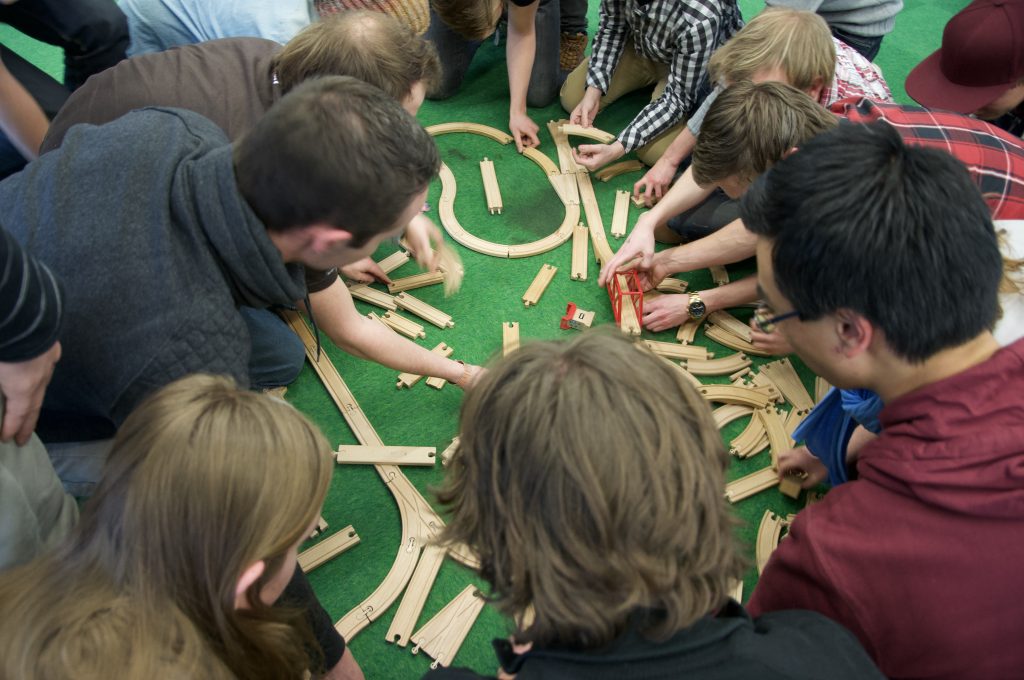
Students taking part in the ’Train Track Trick’ workshop. Image © Joep frens
Introduction
In times of the discussion around wholesale offloading of creative work to automated systems, critical thinking and development of critical understanding in design and HCI are more important than ever. Too often engagement with increasingly high level tools reinforces the mis-conception that interaction with digital systems happens at the surface. That the (commonly) visual instantiation in the world of a system is where the meaning lies. Oblique activities within design, HCI, information and systems architecture, problem framing and many more areas allow students to see beyond the surface [13]. Representing concepts and non-verbal / non-visual meanings as the foundations of comprehension of interaction design. Helping develop an understanding of the underlying conceptual frameworks that link ideas, principles and processes within HCI.
Extant inspirations within parallel disciplines to HCI include the ‘Oblique strategies’ of Schmidt and Eno ’[1] [16], ‘Taking a line for a walk’ [9], ‘Gamestorming’ [10] , ‘Wicked Arts Assignments’ [11], ‘The Photographers Playbook’ [7] and more.
Within design education ‘the Magic Machine workshops’ [3], the ’Deterministic practices’ workshop at CHI’18 [2] and the cultural probe exercises and activities (Gaver, Boehner, Pachenti, Wallace et al) [8] [4] [15] all provide fertile ground to work within. Although they all differ in motivation or application from our proposal they none-the-less provide inspiration to draw from and a context to work within, both in literature and in practice, for this workshop.
Engaging pedagogic practice with oblique or novel activities and experiences enables student cohorts to explore new concepts and perspectives in HCI that are not readily apparent from looking at the surface representations of interfaces. Exploring ideas in this way allow students to see afresh – often by re-presenting or ’making strange’ [13] that which is familiar. Allowing a re-engagement or re-appraisal of established knowledge or engagements with new ideas.
Process and intended audience
We will request each participant to submit one teaching idea, experience, or exercise to share. A short selection from these will be filtered in advance of the face to face workshop day and examples will be shared and discussed and a chosen selection will be played through. At the end of the day all previously submitted experiences will be published complete with a joint introductory text.
During the day we will document the discussion and collaboratively write a short text with observations, feedback, insights and anecdotes from the combined workshop participants. This text will be included into a book compendium of the submitted provocations that will be completed, laid up, published and available on the same day. The book will be available for physical order anywhere in the world – with an ISBN number via a print on demand publisher and also distributed for free as a downloadable, printable PDF version.
Our intended audience foe this workshop is broadly within design and HCI educators and students and those with an interest in alternative and critical arts-orientated pedagogic practice. This is not exclusive in that all experiences and provocations may be equally relevant or adaptable to commercial, industrial, and peer teams wishing to explore problems or concepts in new ways.
The call will be shared though our personal, social and academic networks with email, social media, and online calls supported by a call-website and other online materials.
Proposed Schedule for a one day workshop
In advance.
Within the workshop call we ask participants to submit experiences (one page maximum) they wish to share. These will be laid up into a suitable publication format in advance of the workshop.
On the day.
- Meet and brief, share pre-prepared inspirations and activities. Donuts and coffee.
- Select 2-3 activities to explore as a group
- Work through selected activities and reflect on each
- Lunch
- Play test more experiences
- Propose joint critical statement as preface to book collection. Incorporate into publishable format
- Lay up into pre-prepared book format with participants feedback and shared text
- Publish book via print on demand with ISBN number
- Go for drinks and food
Expected outcomes and impact for the target community
The workshop is intended to build a temporary space for shared knowledge exchange and reflection on design and pedagogy. From this initial day long workshop we will publish a compendium of all contributed experiences combined with reflections and observations from the workshop participants on the day. The book publication will be released with an ISBN number via a print on demand publishing house. This makes the publication readily available as a print-yourself pdf or a physical copy that can be ordered from any bookshop or online seller.
The Organisers
The organisers are all experienced researchers and educators within HCI have broad experience of organising and delivering engaging, successful workshop experiences. They have worked together in different combinations multiple times and are excited to share this workshop with future participants.
Daniel Buzzo
Daniel is an artist, Interaction Designer, Researcher and Professor at CODE University of Applied Sciences, working with new media and creative technologies. He collaborates with students from bachelor to doctoral level within Interaction Design and experimental creative technologies, focussing on critical enquiry and practical experimentation through prototyping. His practice is set within a Research through Design methodology, engaging with tools of media art, Speculative Design combined with rapid prototyping techniques to explore practical manifestations of ideas. He has previously collaborated on workshops at SIGCHI, ICCC, DIS and CCC conferences.[6] [14][5]
Martin Knobel
Martin designs experiences through interactive services and objects. A central element of his practice is an experience- centered approach. The outcomes range from experience-focused research and prototyping in mobility contexts to socially oriented design work and learning formats that treat teaching as a method for inquiry and collaboration. He is Professor in Design at CODE University of Applied Sciences. He was an organizer for a Workshop at AutomotiveUI 2011 addressing the use of natural user interfaces in cars [12].
Kristina Andersen
Kristina Andersen is associate professor at the Making with… cluster of the Department of Industrial Design. Her work is concerned with how we can allow each other to imagine our possible futures through digital craftsmanship and collaborations with machines in the context of material practices of soft fiber-based things. How can we innovate, design and act around that which is yet to be imagined? Who gets to drive innovation processes? And how can we reframe our methodologies to include the complex cultural, political, and personal aspects of life? Can we approach this through making (and thinking) about technology, communities and materials as a way to construct the unknown?
Joep Frens
Joep is associate professor at Eindhoven University of Technology in the department of Industrial Design. His research focuses on the question of ‘how to design for open and growing systems’, with a particular focus on human product interaction in the context of the (smart) home. He teaches courses on (interaction) design on all academic levels and advises a number of PhD students. In the academic year of 2014-2015 he held the Nierenberg Chair of Design at the Carnegie Mellon University School of Design. When he sees a sheet of cardboard he makes a model out of it.
Mark Blythe
Mark Blythe is Professor of Interdisciplinary Design and Creative Lead for AI in Design, Art and the Creative Industries at Northumbria University. He is a design ethnographer working in the field of Human Computer Interaction with a background in social science. His recent research focuses on artificial design fiction and he is the Director of the Centre for Speculative AI.
Main contact daniel.buzzo@code.berlin
References
- 2026. https://en.wikipedia.org/wiki/Oblique_Strategies
- Kristina Andersen, Laura Devendorf, James Pierce, Ron Wakkary, and Daniela K. Rosner. 2018. Disruptive Improvisations: Making Use of Non-Deterministic Art Practices in HCI. In Extended Abstracts of the 2018 CHI Conference on Human Factors in Computing Systems (Montreal QC, Canada) (CHI EA ’18). Association for Computing Machinery, New York, NY, USA, 1–8. doi:10.1145/3170427.3170630
- Kristina Andersen and Ron Wakkary. 2019. The Magic Machine Workshops: Making Personal Design Knowledge. In Proceedings of the 2019 CHI Conference on Human Factors in Computing Systems (Glasgow, Scotland Uk) (CHI ’19). Association for Computing Machinery, New York, NY, USA, 1–13. doi:10.1145/3290605.3300342
- Kirsten Boehner, William Gaver, and Andy Boucher. 2012. Probes. In In Inventive Methods: the Happening of the Social, Celia Lury and Nina Wakeford (Eds.). Routledge Press, London, 185–201. https://research.gold.ac.uk/id/eprint/7400/
- Daniel Buzzo and Kristina Andersen. 2020. CCC-WS 2020: Joint Workshops of the International Conference on Computational Creativity.
- Daniel Buzzo, Kristina Andersen, António Gorgel, Jonathan Pérez, Martin Knobel, Lara Piccolo, and Pras Gunasekera. 2025. Learning by teaching blended international design workshops. In LearnXDesign 2025. Design Research Society.
- Jason Fulford, Greg Halpern, and Mike Slack. 2014. The photographer’s Playbook: 307 assignments and ideas. Aperture.
- Bill Gaver, Tony Dunne, and Elena Pacenti. 1999. Design: Cultural probes. Interactions 6, 1 (Jan. 1999), 21–29. doi:10.1145/291224.291235
- Corinne Gisel, Nina Paim, and Emilia Bergmark. 2021. Taking a line for a walk assignments in Design Education Corinne Gisel Aut; Nina Paim edit.; Emilia Bergmark Edit.; Moravian Gallery brno aut. Spector Books.
- Dave Gray. 2024. Gamestorming: A Playbook for innovators, rulebreakers, and Changemakers. O’Reilly Media.
- Emiel Heijnen and Melissa Bremmer. 2021. Wicked arts assignments: Practising creativity in contemporary arts education. Valiz.
- Bastian Pfleging, Albrecht Schmidt, Tanja Döring, and Martin Knobel. 2011. AutoNUI. In Proceedings of the 3rd International Conference on Automotive User Interfaces and Interactive Vehicular Applications (Salzburg Austria). ACM, New York, NY, USA, 207–209.
- Viktor B Scholvsky. 2012. Art as technique. University of Nebraska Press.
- Carl Hayden Smith, Daniel Buzzo, and Eyal Gruss. 2021. EVA London 2021 Workshops, Introduction to Generative Drawing. (2021).
- Jayne Wallace, John McCarthy, Peter C. Wright, and Patrick Olivier. 2013. Making design probes work. In Proceedings of the SIGCHI Conference on Human Factors in Computing Systems (Paris, France) (CHI ’13). Association for Computing Machinery, New York, NY, USA, 3441–3450. doi:10.1145/2470654.2466473
- Brandon Walsh. 2019. Thirteen oblique strategies for digital pedagogy. https://walshbr.com/blog/oblique-digital-pedagogy/